 78a7e5ec18
Expand the README intro with a stronger project summary (incl. GLM-5.2/OpenCode origin, ~4M input / ~800K output tokens, ~$82), a Features list, and a Tech Highlights section (SSE, custom migration system, Playwright E2E, Vitest, etc.). Existing content continues below.
OpenGroupware
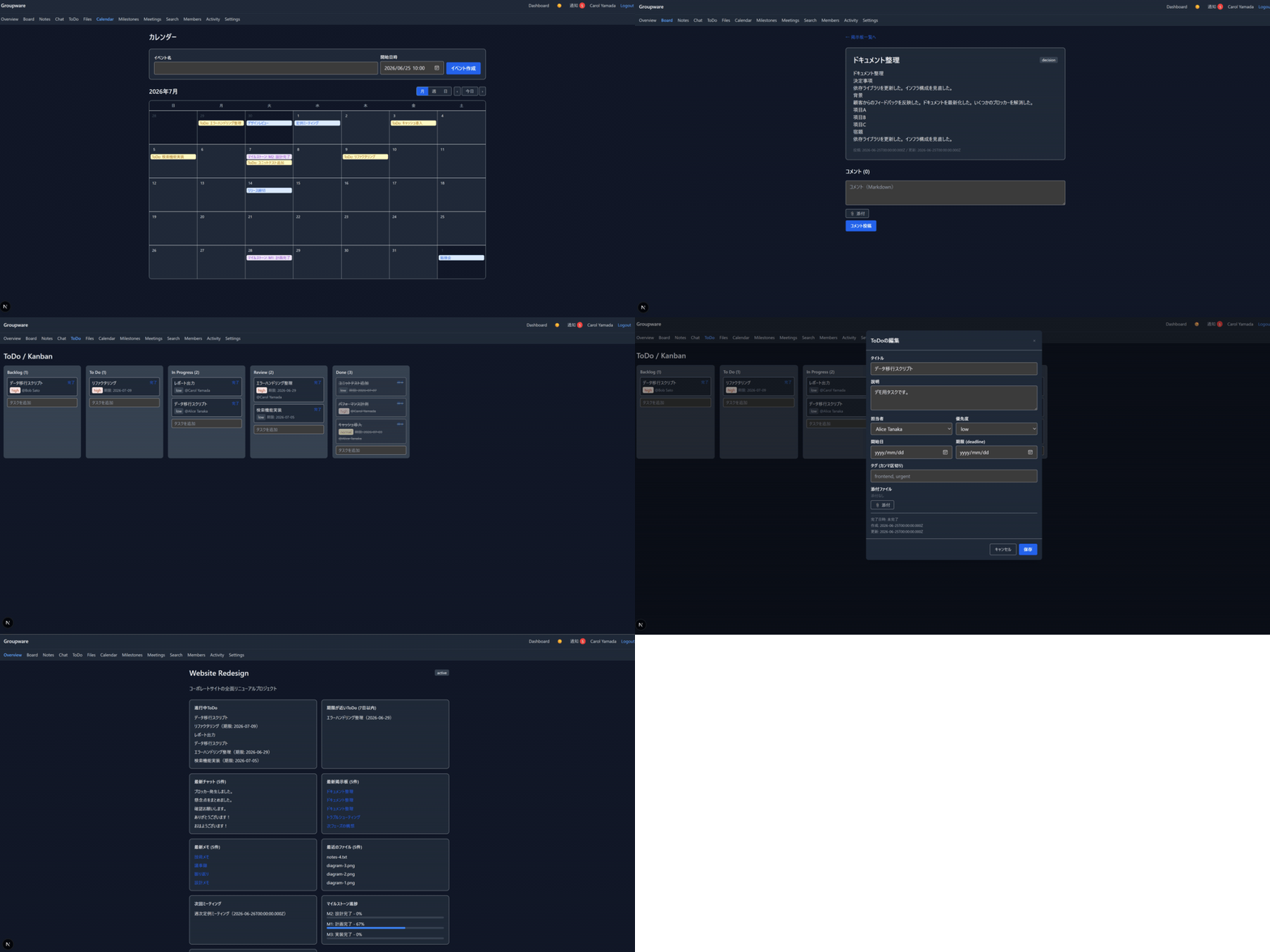
OpenGroupware is a full-featured, self-contained, project-based groupware built with Next.js 15, TypeScript, and SQLite. It runs entirely on Node.js — no external database, cache, or object storage — and packs boards, realtime chat, a Kanban ToDo board, Markdown notes, file sharing, a calendar with milestones, meetings with schedule-conflict detection, search, dashboards, notifications, and admin backups into a single deployable app.
Origin: This project was built as a test of GLM-5.2 with OpenCode. The vast majority of the codebase was generated autonomously, without human interaction. Total usage: ~4M input tokens, ~800K output tokens, ~$82 in API cost.
Features
- Project workspaces — multi-project, with member roles (admin / member / guest) and permission-checked access throughout
- Boards — threaded discussions with Markdown, categories, pinning, important flags, and file/image attachments
- Realtime chat — per-project SSE live messages with @mentions and attachments (auto-reconnect via
EventSource) - Kanban ToDo board — drag-and-drop columns & cards, priorities, assignees, start/due dates, tags, milestones, and attachments
- Markdown notes — pinned notes, tags, full search, and sanitized rendering
- File sharing — uploads with a lightbox, library + attachment sources, and project-scoped storage
- Calendar — month/week/day views with events linked to todos, milestones, and meetings
- Milestones — due dates, status, and progress roll-up across todos
- Meetings — agenda & minutes (Markdown), invited members, and schedule-conflict detection
- Search & dashboards — cross-project search and a personal dashboard
- Notifications & activity log — mentions, assignments, due-soon, and meeting invites, plus a per-project audit trail
- Admin tools — one-click backup (SQLite DB + uploads → ZIP), download, and migration status (system_admin only)
- Auth — bcrypt password hashing, stateless signed-cookie sessions, and system_admin / member roles
- PWA & mobile — installable, responsive, with an offline shell
- Theme & i18n — dark/light theme and English / Japanese UI
Tech Highlights
- Strict layered architecture —
UI (app/) → Service (services/) → Repository (repositories/) → Data (lib/db/); one-way dependencies, SQL isolated in repositories - Realtime via SSE — a tiny in-memory
SseHub(lib/sse/hub.ts) broadcasts events to per-project clients; services inject the hub and fire events on writes - Custom SQL migration system —
Migrator(lib/db/migrator.ts) applies versionedlib/db/migrations/NNN_*.sqlfiles in filename order, each in its own transaction and recorded inschema_migrations— no ORM, no external CLI - SQLite wrapper —
SqliteDatabasecentralizesbetter-sqlite3access with WAL mode,foreign_keys = ON, parameter binding, and transactions; repositories never touch the driver directly - Stateless signed sessions —
base64url(payload).base64url(hmacSha256(secret, payload))cookies verified withcrypto.timingSafeEqualand aniatexpiry - Playwright E2E tests —
webServerauto-runsmigrate && dev, aglobalSetupseeds the admin account,workers: 1for deterministic SSE; 15 specs cover every major user flow - Vitest unit & integration tests — 326 tests across 38 files using a real temporary SQLite DB per test, with an 80% coverage threshold on repositories and services
- Soft deletes everywhere —
deleted_at IS NULLfiltering enforced in repository queries - XSS-safe Markdown —
react-markdown+remark-gfm+rehype-sanitize; HTML and dangerous URL schemes are stripped - Key algorithms, unit-tested — schedule-conflict detection, milestone progress calculation, notification targeting, and session-token verification
- Spec-driven workflow — opencode-driven design docs (
docs/) and per-task steering files (.steering/) keep planning and implementation traceable
The codebase follows a strict layered architecture:
UI (app/) → Service (services/) → Repository (repositories/) → Data (lib/db/)
Dependencies flow one direction only; SQL is always parameter-bound and accessed through the
SqliteDatabase wrapper (never better-sqlite3 directly in repositories).
Table of Contents
- Prerequisites
- How to Start
- How to Test
- How to Develop
- Environment Variables
- Project Structure
- npm Scripts Reference
- Troubleshooting
- License
Prerequisites
- Node.js v24.11.0 (LTS; v18+ works) — the dev container pins this version
- npm 11.x (bundled with Node.js)
- Playwright browsers for E2E tests (see How to Test)
A Dev Container configuration (.devcontainer/) is included for VS Code.
How to Start
# 1. Install dependencies
npm install

# 2. Create your local environment file
cp .env.example .env
#   Edit .env if you want to change SQLITE_PATH / SESSION_SECRET / UPLOADS_PATH.
#   SESSION_SECRET is required — the app will not start without it.

# 3. Initialize the database (runs all SQL migrations)
npm run migrate

# 4. Start the development server
npm run dev
The app is then available at http://localhost:3000.
- The first user you register becomes a regular
member. To use admin features (backups, migration status), promote a user tosystem_adminin the DB, or seed one:npx tsx -e "import('./lib/db/sqlite.ts').then(async m => { \ const { UserRepository } = await import('./repositories/UserRepository.ts'); \ const bcrypt = (await import('bcrypt')).default; \ const db = new m.SqliteDatabase(process.env.SQLITE_PATH ?? './data/app.db'); \ new UserRepository(db).create({ name:'Admin', email:'admin@example.com', \ passwordHash: bcrypt.hashSync('admin123', 10), role:'system_admin' }); db.close(); })" - The SQLite database lives at
./data/app.db(and uploads under./data/uploads/). Both are git-ignored. Deleting./data/and re-runningnpm run migrategives a clean slate.
Production build
npm run build
npm run start      # serves the optimized build on http://localhost:3000
How to Test
There are three test layers: Unit/Integration (Vitest) and E2E (Playwright).
Unit & integration tests (Vitest)
npm test                 # run all unit/integration tests once
npm run test:watch       # watch mode
npm run test:coverage    # run with coverage (threshold: 80% for repositories/** + services/**)
These use a real temporary SQLite database per test (see tests/helpers/db.ts) and cover every
Repository, Service, and the key algorithms (schedule-conflict, milestone progress, session tokens,
notification targeting).
End-to-end tests (Playwright)
npm run test:e2e         # run the full E2E suite (headless)
npm run test:e2e:ui      # interactive UI mode — test tree + per-step screenshots/traces
Before running E2E:
# Install the Chromium browser once (per machine)
npx playwright install chromium
How E2E works:
- Playwright's
webServerrunsnpm run migrate && npm run devautomatically, so the DB is initialized and the dev server is started for you. - A
globalSetup(tests/e2e/globalSetup.ts) seeds anadmin@example.com/admin123(system_admin) account used by the admin/backup tests. - The suite runs with
workers: 1for deterministic behavior (the realtime SSE test needs low contention against the single dev server). - E2E specs live in
tests/e2e/*.spec.ts(auth, project-management, board, notes, chat-sse, todo-kanban, file-sharing, calendar, meetings, search/dashboard, notifications, activity-log, backup).
Lint, type-check, build
npm run lint
npm run typecheck
npm run build
Run all three green before committing. A pre-commit hook (Husky + lint-staged) auto-fixes and formats staged files.
Recommended full check before opening a PR
npm run lint && npm run typecheck && npm test && npm run build && npm run test:e2e
How to Develop
Typical workflow
- Branch from
main:git checkout -b feature/<name>(orfix/,refactor/). - Implement following the layered architecture and coding conventions (see
docs/development-guidelines.md):- Route handlers in
app/api/.../route.tsstart withexport const runtime = 'nodejs';(Edge runtime is forbidden because of better-sqlite3). - Services do permission checks and call repositories; repositories hold SQL and use parameter
binding (
@param) anddeleted_at IS NULLfor soft-deleted tables. - Map DB
snake_casecolumns to camelCase entity fields in repository mappers. - All list endpoints paginate (
LIMIT/OFFSET).
- Route handlers in
- Add Unit tests for any new Repository/Service, and an E2E spec for user-facing flows.
- Ensure
npm run lint,npm run typecheck,npm test, andnpm run buildare green. - Merge to
main(merge commit). Milestones in this project were delivered one per branch, each merged tomainbefore the next branched off.
Database migrations
Migrations are plain SQL files in lib/db/migrations/, named NNN_description.sql and run in
filename order. Each file runs in its own transaction and is recorded in schema_migrations.
npm run migrate # apply pending migrations
To add a schema change, create e.g. lib/db/migrations/002_add_column.sql and re-run
npm run migrate. Never edit an already-applied migration — add a new one.
Realtime (SSE)
lib/sse/hub.ts (SseHub) keeps an in-memory set of clients per project and broadcasts events only
to that project's clients. Services inject the hub and call broadcast(projectId, event); the
stream endpoint GET /api/projects/:projectId/chat/stream registers a client and cleans up on
abort. The chat UI uses EventSource (auto-reconnect).
Sessions & auth
Stateless signed-cookie sessions (lib/auth/session.ts): the cookie is
base64url({uid,iat}).base64url(hmacSha256(secret, payload)), verified server-side with
crypto.timingSafeEqual and an iat expiry check. middleware.ts does a coarse cookie-presence
redirect for pages; the real HMAC + DB verification happens in getCurrentUser (Node runtime).
Where things live
| Concern | Location |
|---|---|
| Pages & API routes | app/ |
| Business logic, permissions | services/ |
| SQL & data access | repositories/ |
| DB wrapper, migrations, SSE, auth, types, validators | lib/ |
| React components | components/ |
| Tests | tests/unit, tests/integration, tests/e2e |
Spec-driven workflow (optional)
This project also ships an opencode spec-driven workflow (see AGENTS.md, docs/, .steering/,
.opencode/). Persistent design docs live in docs/; per-task plans live in
.steering/[YYYYMMDD]-[name]/. You can drive new work with /add-feature <name> in opencode, but
normal Git + npm development works too.
Environment Variables
Configured via .env (copy from .env.example):
| Variable | Default | Purpose |
|---|---|---|
SQLITE_PATH |
./data/app.db |
SQLite database file path |
SESSION_SECRET |
(must set) | HMAC secret for signing session cookies |
UPLOADS_PATH |
./data/uploads |
Directory for uploaded files |
SESSION_SECRET must be set — the app throws on startup if it is missing. Never commit .env.
Project Structure
.
├── app/                 # Next.js App Router: pages + Route Handlers (all runtime='nodejs')
│   ├── api/             # REST/SSE endpoints
│   ├── projects/[projectId]/  # project screens (board, notes, chat, todos, files, calendar, ...)
│   ├── admin/backups/   # admin-only backup screen
│   └── login / profile / dashboard / notifications
├── lib/
│   ├── db/              # SqliteDatabase, Migrator, migrations/*.sql
│   ├── sse/             # SseHub
│   ├── auth/            # session, getCurrentUser
│   ├── types/           # entity & event types
│   ├── validators/      # input validators
│   ├── api/             # service factories + error handling for route handlers
│   └── errors.ts        # AppError hierarchy (ValidationError, ForbiddenError, ...)
├── repositories/        # one class per table (SQL + mapping)
├── services/            # business logic + permission checks + side effects
├── components/          # React components by area (layout, board, chat, todo, ...)
├── tests/
│   ├── unit/            # Vitest — mirrors source structure
│   ├── integration/     # Vitest — real temp SQLite DB
│   ├── e2e/             # Playwright specs + globalSetup.ts
│   └── helpers/db.ts    # createTestDb() / createMigratedTestDb()
├── data/                # git-ignored: app.db, uploads/
├── backups/             # git-ignored: backup-<timestamp>.zip
├── docs/                # persistent design docs (PRD, architecture, milestones, ...)
└── .steering/           # per-task plans (git-ignored working artifacts)
npm Scripts Reference
| Script | Description |
|---|---|
npm run dev |
Start the Next.js dev server (http://localhost:3000) |
npm run build |
Production build |
npm run start |
Serve the production build |
npm run lint |
ESLint |
npm run format |
Prettier (write) |
npm run typecheck |
tsc --noEmit |
npm test |
Run unit/integration tests (Vitest, once) |
npm run test:watch |
Vitest watch mode |
npm run test:coverage |
Vitest with coverage (80% threshold on repos+services) |
npm run test:e2e |
Playwright E2E (headless, full suite) |
npm run test:e2e:ui |
Playwright interactive UI mode (screenshots + traces) |
npm run migrate |
Apply SQL migrations |
Troubleshooting
- App won't start:
SESSION_SECRET is not configured— create.envfrom.env.exampleand setSESSION_SECRET. npm run migratefails with "more than one statement" — ensure the migrator usesSqliteDatabase.exec()(it does); this is a historical footgun withbetter-sqlite3'sprepare().- E2E:
Executable doesn't exist— runnpx playwright install chromium. - E2E: tests flaky/failing — the suite is pinned to
workers: 1; ensure no othernpm run devis occupying port 3000, and remove./data/before a clean run. - Port 3000 busy — stop the other process (
lsof -ti:3000 | xargs kill) before running dev/E2E.
License
MIT — see LICENSE.